
Transaction Continuity
Connect goods received, warehouse movement, deliveries, sales and returns through consistent inventory records.
Manage item records, warehouse balances, receipts, issues, valuation and adjustments while keeping inventory activity aligned with purchasing, sales and invoicing.
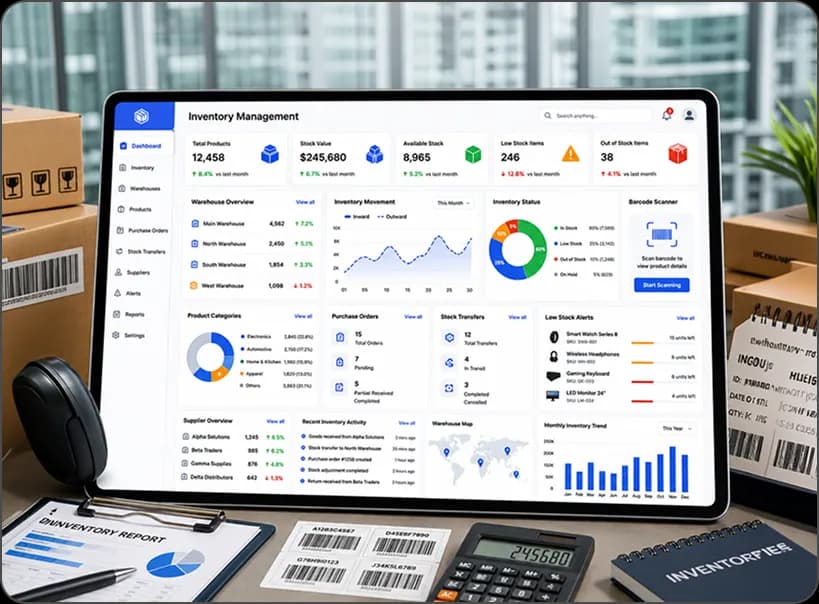
Purchases, sales and stock movement are closely linked. When these records are maintained separately, differences become harder to explain and transaction activity becomes more difficult to review across organisations, locations and reporting periods.
Connect goods received, warehouse movement, deliveries, sales and returns through consistent inventory records.
Maintain a clearer view of available stock and movement across warehouses and operating locations.
Apply defined valuation methods and adjustments to maintain consistent inventory and financial records.
Inventory Management brings together the item, movement, location and valuation records required to maintain accurate stock information across day-to-day operations.
Maintain records with SKUs, measurements, pricing, and reorder info.
Record goods received against purchasing activity and update the relevant warehouse balances.
PO-20541
Steel Sheets
PO-20542
Packaging Boxes
Manage stock in multiple warehouses, keeping location balances.
Warehouse Capacity
Track movements from purchases, deliveries, sales, returns, and transfers.
Maintain batch or serial references for items that require closer identification and movement tracking.
QR Code
 Qty 1250 Units
Use FIFO or average valuation, set low-stock thresholds, and record corrections.
Inventory Value
$3.85M
Define items, units, pricing, tax settings, opening balances, and storage locations for efficient inventory administration.
Capture goods received through purchase and receipt records, updating stock quantities within the relevant warehouse or location.
Maintain outward movement through deliveries, sales and returns while preserving a traceable record of where stock moved and why.
Review stock ledgers, balances, valuation & low-stock positions, with authorised adjustments recorded where required.
Inventory Management provides the access, document and record controls required to maintain accountability across organisations, warehouses and stock activity.
Maintain inventory records for multiple organisations through controlled access within the same environment.
Reflect purchasing, goods receipt, delivery and sales activity within the corresponding inventory records.
Connect relevant sales and purchase activity with accounting records to reduce differences between stock and financial information.
Apply controlled numbering across purchase orders, goods receipts, deliveries, invoices and related records.
Assign inventory responsibilities through defined user roles and permissions for administrators, accountants, managers and auditors.
Review user actions and changes to relevant records to maintain stronger administrative accountability.
Maintain structured item and stock records across organisations with different transaction volumes, storage models and operating requirements.
Approved feedback from organisations and government stakeholders on stock visibility, record consistency and multi-location inventory control.
“Inventory tracking has become much more accurate across every warehouse. Real-time stock visibility helps us plan and operate more efficiently.”
Industrial Manufacturing Ltd.
“Batch tracking, stock movements and warehouse management are now handled from one centralized dashboard, improving operational efficiency.”
Logistics Corporation
“The system provides complete control over inventory while reducing stock discrepancies and improving purchasing decisions.”
Distribution Network Ltd.
Important considerations around warehouse structures, stock movement, valuation, access controls and the relationship between inventory and financial records.
Inventory Management supports item and unit records, warehouses, stock receipts, inward and outward movement, batch or serial tracking, valuation, low-stock alerts and authorised stock adjustments within one controlled environment.
Inventory Management supports item and unit records, warehouses, stock receipts, inward and outward movement, batch or serial tracking, valuation, low-stock alerts and authorised stock adjustments within one controlled environment.
Inventory Management supports item and unit records, warehouses, stock receipts, inward and outward movement, batch or serial tracking, valuation, low-stock alerts and authorised stock adjustments within one controlled environment.
Inventory Management supports item and unit records, warehouses, stock receipts, inward and outward movement, batch or serial tracking, valuation, low-stock alerts and authorised stock adjustments within one controlled environment.
Inventory Management supports item and unit records, warehouses, stock receipts, inward and outward movement, batch or serial tracking, valuation, low-stock alerts and authorised stock adjustments within one controlled environment.
Inventory Management supports item and unit records, warehouses, stock receipts, inward and outward movement, batch or serial tracking, valuation, low-stock alerts and authorised stock adjustments within one controlled environment.